
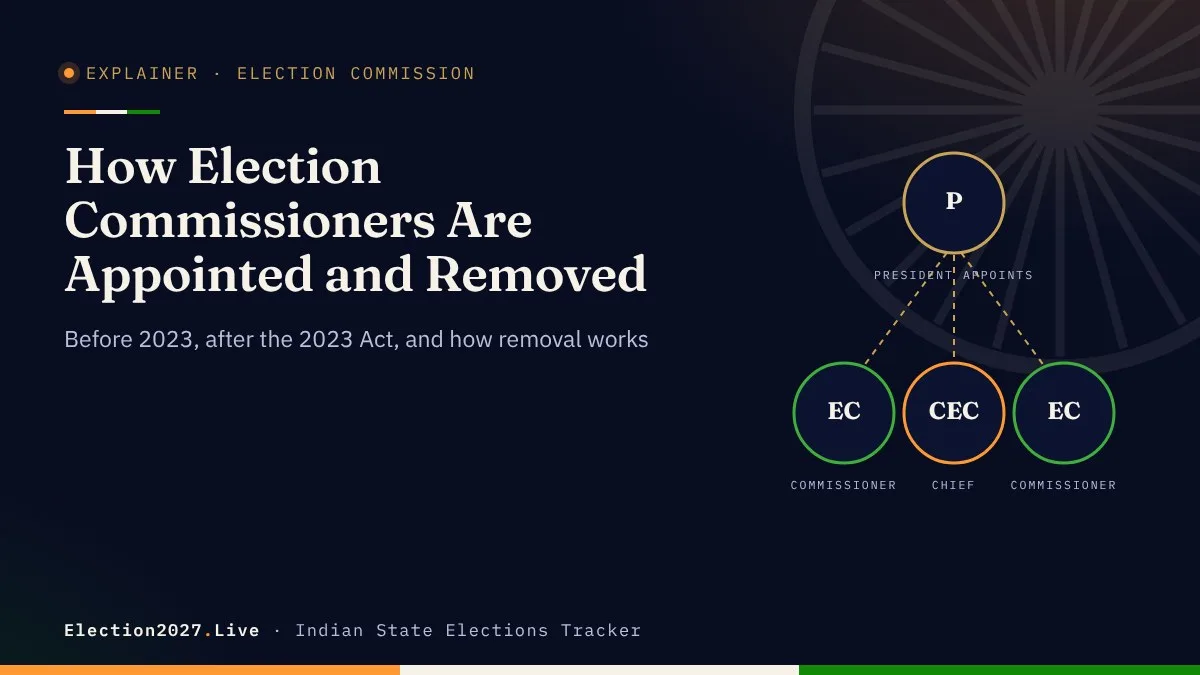
The Election Commission of India (ECI) has a Chief Election Commissioner (CEC) and two Election Commissioners (ECs). Who appoints them, and how they can be removed, is set by Article 324 of the Constitution and, since 2023, by a dedicated law. This guide covers both questions: how appointments worked before 2023, what changed, and how removal works.
In short: Before 2023, the President appointed the CEC and ECs on the advice of the Union government, with no law on how to choose them. Since the 2023 Act, a selection committee of the Prime Minister, a Union Cabinet Minister and the Leader of Opposition recommends the names. A CEC can be removed only like a Supreme Court judge — by Parliament, with a special majority. An EC can be removed only on the CEC's recommendation.
How the Election Commissioner was appointed before 2023
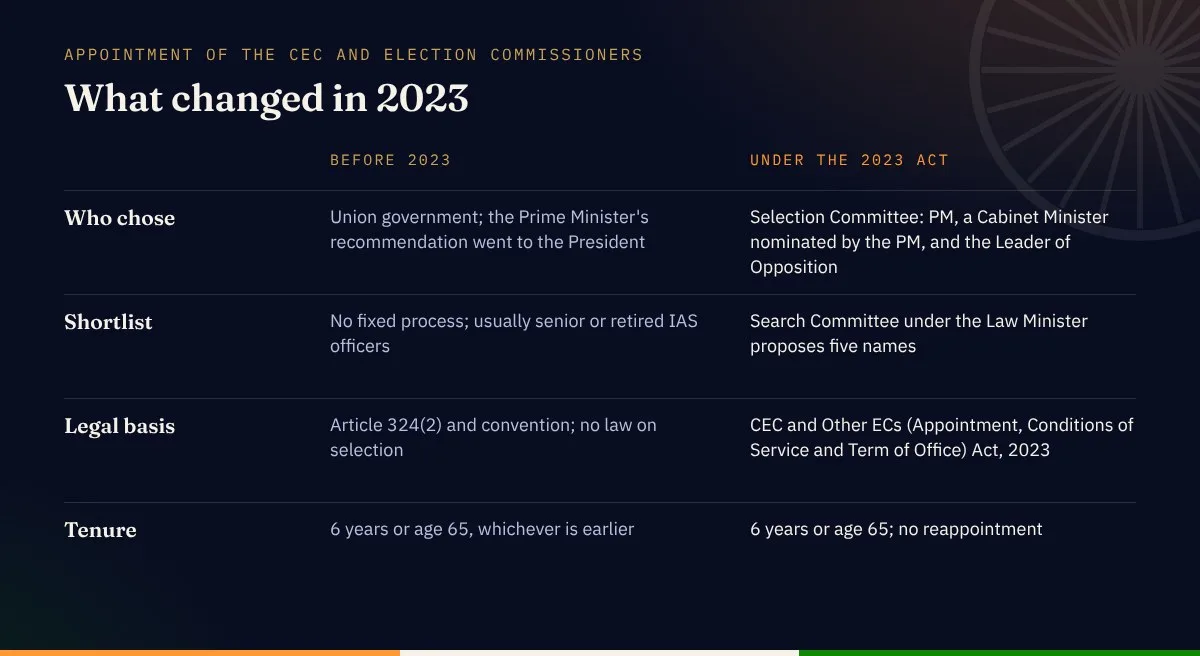
Article 324(2) says the CEC and other ECs are appointed by the President, "subject to the provisions of any law made in that behalf by Parliament." For more than 70 years, Parliament made no such law on the selection process. In practice:
- The Law Ministry prepared a shortlist, usually of serving or retired senior civil servants (most often IAS officers of Secretary rank).
- The Prime Minister chose a name from it.
- The President made the appointment on the government's advice, as with most executive appointments.
- By convention, the senior-most Election Commissioner was usually elevated as CEC when the post fell vacant.
The Election Commission (Conditions of Service of Election Commissioners and Transaction of Business) Act, 1991 set the salary and the term — six years or until age 65, whichever came first — but did not say how commissioners were to be chosen. The Commission had a single member until 1989; two additional ECs were appointed briefly in 1989–90, and it has been a three-member body permanently since 1993.
Why the old system was challenged
Critics argued that letting the government of the day pick the referee of elections undermined the Commission's independence, and several expert bodies, including the Goswami Committee (1990) and the Law Commission (2015), recommended a broader selection panel. Petitions reached the Supreme Court.
The Anoop Baranwal judgment (March 2023)
On 2 March 2023, a five-judge Constitution Bench of the Supreme Court in Anoop Baranwal v. Union of India ruled that, until Parliament made a law, the CEC and ECs would be appointed by the President on the advice of a committee of:
- the Prime Minister,
- the Leader of Opposition in the Lok Sabha (or the leader of the largest opposition party), and
- the Chief Justice of India.
The Court modelled this on the panel used to select the CBI Director.
How Election Commissioners are appointed now: the 2023 Act
Parliament then passed the Chief Election Commissioner and Other Election Commissioners (Appointment, Conditions of Service and Term of Office) Act, 2023 in December 2023; it came into force in January 2024. It replaced the court's interim arrangement:
- Search Committee: headed by the Union Law Minister with two officers not below the rank of Secretary. It prepares a panel of five names.
- Selection Committee: the Prime Minister (chair), a Union Cabinet Minister nominated by the Prime Minister, and the Leader of Opposition in the Lok Sabha (or the leader of the single largest opposition party). It can also consider names outside the panel.
- Appointment: by the President on the Selection Committee's recommendation. An appointment is not invalid just because the committee has a vacancy.
- Eligibility: people who hold or have held a post equivalent to Secretary to the Government of India, with experience in managing and conducting elections.
- Term: six years or until age 65; no reappointment.
The key change from Anoop Baranwal is that the Chief Justice of India was replaced by a Cabinet Minister, giving the government two of the three votes. The first appointments under the Act were made in March 2024, and Gyanesh Kumar became CEC under it in February 2025.
The legal challenge
Petitions challenging the 2023 Act are pending in the Supreme Court. On 23 September 2026, a two-judge bench gave a split verdict on whether the case should go to a larger bench, and the matter was referred to the Chief Justice for a Constitution Bench. The Act remains in force until the Court decides otherwise.
How an Election Commissioner is removed
Removal of the Chief Election Commissioner
Article 324(5) says the CEC "shall not be removed from his office except in like manner and on the like grounds as a Judge of the Supreme Court." The 2023 Act repeats this. The grounds are only proved misbehaviour or incapacity, and the process follows Article 124(4) and the Judges (Inquiry) Act, 1968:
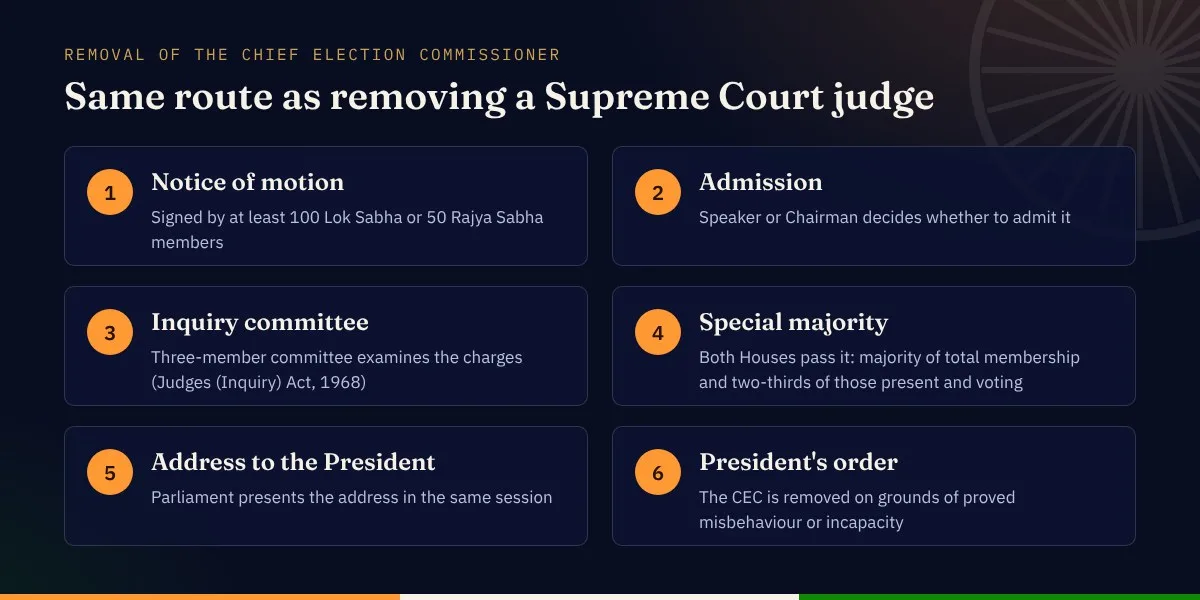
- A notice of motion signed by at least 100 Lok Sabha or 50 Rajya Sabha members.
- The Speaker or Chairman decides whether to admit it.
- If admitted, a three-member inquiry committee investigates the charges.
- If the committee finds the charges proved, each House must pass the motion by a special majority: a majority of its total membership and two-thirds of members present and voting.
- An address is presented to the President in the same session.
- The President orders the removal.
The conditions of service of a CEC also cannot be changed to his disadvantage after appointment, which protects the post from pressure through pay or perks.
Removal of an Election Commissioner
The two ECs have weaker protection: under Article 324(5), an Election Commissioner can be removed only on the recommendation of the Chief Election Commissioner. The 2023 Act keeps this rule. Critics, including Justice Dipankar Datta in his September 2026 opinion, have argued that the selection and removal rules together leave too much power with the executive; the government's position is that Parliament is entitled to legislate on appointments under Article 324.
Has a CEC ever been removed?
No CEC has ever been removed. In March 2026, opposition MPs submitted the first-ever notices in both Houses seeking the removal of CEC Gyanesh Kumar, alleging bias and mass disenfranchisement through the voter-roll revision; the Lok Sabha Speaker and Rajya Sabha Chairman rejected them in April 2026 without giving reasons. A fresh notice was then submitted in the Rajya Sabha, and opposition parties said in September 2026 that they were preparing another. The ECI has defended the voter-roll revision as part of its constitutional duty.
Frequently asked questions
How was the Election Commissioner appointed before 2023?
By the President on the advice of the Union government. The Prime Minister picked a name from a shortlist prepared by the Law Ministry; there was no law on the selection process.
Who appoints the Chief Election Commissioner now?
The President, on the recommendation of a Selection Committee of the Prime Minister, a Union Cabinet Minister nominated by the PM, and the Leader of Opposition in the Lok Sabha.
How is the Chief Election Commissioner removed?
Only in the same way as a Supreme Court judge: a motion passed by both Houses of Parliament with a special majority on grounds of proved misbehaviour or incapacity, followed by the President's order.
How is an Election Commissioner removed?
Only on the recommendation of the Chief Election Commissioner.
What is the term of the CEC?
Six years or until the age of 65, whichever is earlier.
Sources: Constitution of India, Article 324; Election Commission (Conditions of Service of Election Commissioners and Transaction of Business) Act, 1991; Anoop Baranwal v. Union of India (2023); Chief Election Commissioner and Other Election Commissioners Act, 2023; Supreme Court order of 23 September 2026 (as reported by SC Observer, ThePrint and The Wire); reporting by PTI, The Wire and Scroll on the 2026 removal notices.