
India's first general election was held between 25 October 1951 and 21 February 1952. It elected the first Lok Sabha and, at the same time, most state legislative assemblies. The Indian National Congress won 364 of the 489 Lok Sabha seats, and Jawaharlal Nehru became the country's first elected Prime Minister. The first Lok Sabha was constituted in April 1952.
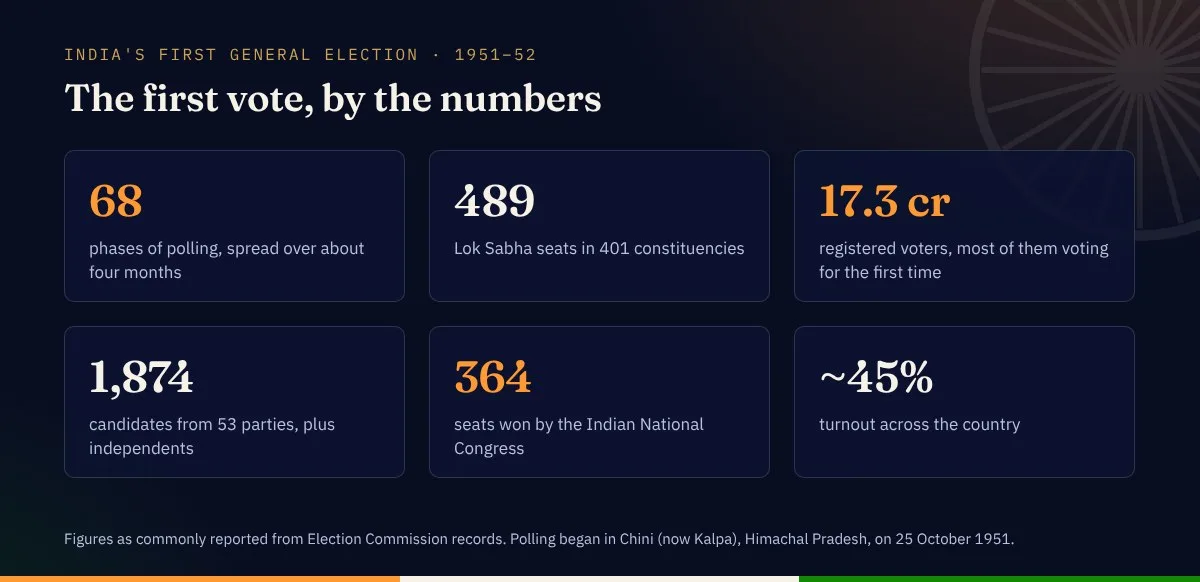
First general election of India: quick facts
| Polling period | 25 October 1951 – 21 February 1952 |
| Phases | 68 |
| Lok Sabha seats | 489, in 401 constituencies |
| Registered voters | About 17.3 crore |
| Turnout | About 45% |
| Candidates | 1,874, from 53 parties plus independents |
| Largest party | Indian National Congress, 364 seats |
| Prime Minister | Jawaharlal Nehru |
| Chief Election Commissioner | Sukumar Sen |
| First votes | Chini (now Kalpa), Himachal Pradesh, 25 October 1951 |
Why the election took four months
The Constitution came into force on 26 January 1950, and the Election Commission of India had been set up a day earlier, on 25 January 1950, with Sukumar Sen as the first Chief Election Commissioner. Parliament passed the Representation of the People Act in 1950 and again in 1951 to lay down how voters, constituencies and elections would work.
The scale was unprecedented. Most of the 17 crore voters had never voted before, and a large majority could not read or write. The Commission had to register every adult over 21 — the voting age then — map constituencies, train lakhs of polling staff and reach villages in deserts, jungles and mountains. Polling was spread over 68 phases so that staff and police could move from region to region.
Who voted first?
Polling began in the snow-bound Chini tehsil of Himachal Pradesh (today's Kalpa, in Kinnaur district) on 25 October 1951, months ahead of the rest of the country, because winter snow would have cut it off later. Schoolteacher Shyam Saran Negi, who voted there, came to be honoured as independent India's first voter; he kept voting in every election until his death in November 2022, at the age of 105.
How people voted without reading
Because so many voters could not read, each candidate was given a separate ballot box marked with a party symbol, such as the Congress's pair of bullocks. Voters dropped a ballot paper into the box of the candidate they supported. To stop people voting twice, polling staff marked each voter's finger with indelible ink, applied with a glass rod; the Commission's report on the election counts about 3.9 lakh phials of it. The ink formula supplied by Mysore Paints and Varnish, still used today, came in 1962. Some constituencies elected two members, one of them from a reserved category, which is why there were more seats (489) than constituencies (401).
The result
| Party | Lok Sabha seats |
|---|---|
| Indian National Congress | 364 |
| Communist Party of India | 16 |
| Socialist Party | 12 |
| Kisan Mazdoor Praja Party | 9 |
| Others and independents | 88 |
Congress won about 45% of the votes and an overwhelming majority of seats. The CPI emerged as the largest opposition group. B. R. Ambedkar, contesting from Bombay, lost his seat. The first Lok Sabha held its first sitting in May 1952, with G. V. Mavalankar as Speaker.
Why it still matters
The 1951–52 election showed that universal adult franchise could work in a large, poor and mostly unlettered country, and many of its methods — party symbols, indelible ink, a permanent Election Commission, phased polling — are still the backbone of Indian elections. Ballot boxes gave way to EVMs, used across the country from 2004, but the basic idea of reaching every voter, however remote, has not changed. In 2027, the same Commission will run Assembly elections in seven states; see which states have elections in 2027.
Frequently asked questions
When was the first general election held in India?
From 25 October 1951 to 21 February 1952.
Who was the first Chief Election Commissioner of India?
Sukumar Sen, who conducted the first two general elections (1951–52 and 1957).
Who won India's first general election?
The Indian National Congress, with 364 of 489 seats. Jawaharlal Nehru became Prime Minister.
Who was India's first voter?
Shyam Saran Negi of Kalpa (then Chini), Himachal Pradesh, who voted on 25 October 1951 when polling there was held early because of snow.
What was the voting age in the first election?
21 years. It was lowered to 18 by the 61st Constitutional Amendment, which took effect in 1989.
Sources: Election Commission of India, Report on the First General Elections in India 1951–52; Lok Sabha Secretariat. Figures such as turnout are commonly reported rounded values.