
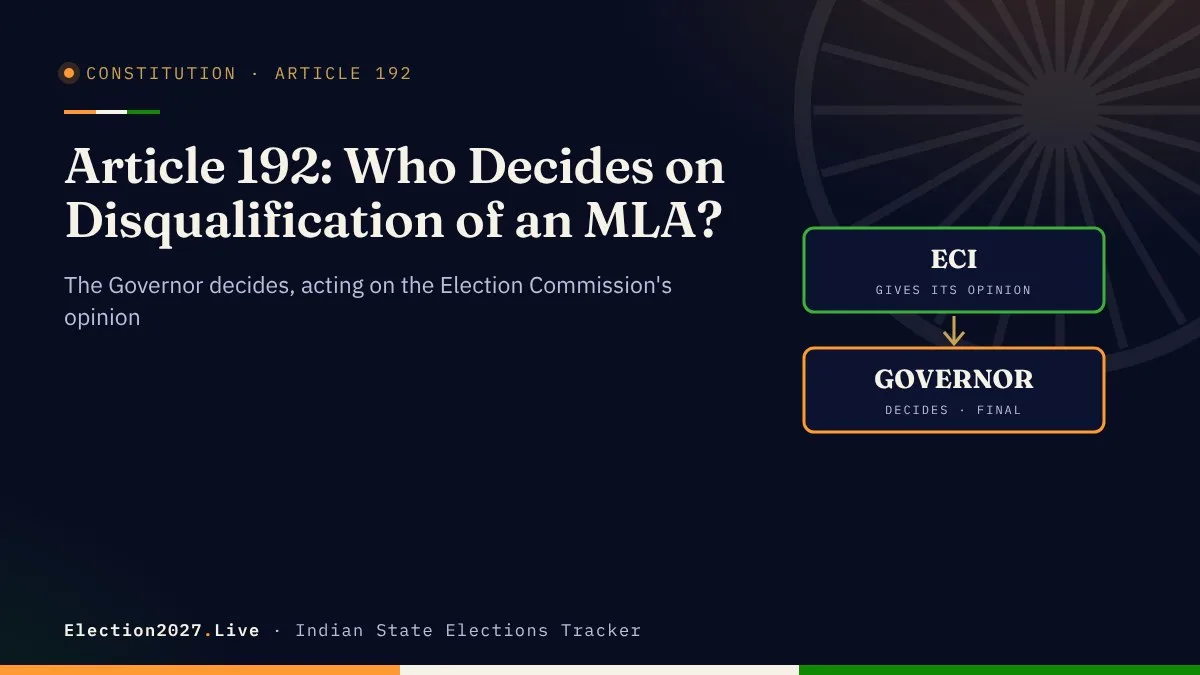
Short answer: under Article 192 of the Constitution of India, the Governor of the state decides whether a member of the state legislature (an MLA or MLC) has become disqualified. Before deciding, the Governor must obtain the opinion of the Election Commission of India (ECI) and must act according to that opinion. The Governor's decision is declared to be final.
One-line exam answer: The Governor, acting on the opinion of the Election Commission. Article 192 covers disqualifications under Article 191(1). Disqualification for defection is different — it is decided by the Speaker under the Tenth Schedule.
What Article 192 says
Article 192 has two parts:
- Clause (1): if a question arises whether a member of a House of the state legislature has become subject to any of the disqualifications in Article 191(1), the question is referred to the Governor, and the Governor's decision is final.
- Clause (2): before giving any decision, the Governor shall obtain the opinion of the Election Commission and shall act according to such opinion.
So although the Governor formally decides, the ECI's opinion is binding. The Governor cannot act on the advice of the state Council of Ministers here, and cannot take a different view from the Commission.
Grounds for disqualification under Article 191(1)
A person is disqualified from being, or remaining, an MLA if they:
- hold an office of profit under the Government of India or a state government (other than an office exempted by law);
- are of unsound mind, as declared by a competent court;
- are an undischarged insolvent;
- are not a citizen of India, or have voluntarily acquired the citizenship of another country;
- are disqualified by or under any law made by Parliament — for example under the Representation of the People Act, 1951, which covers grounds such as failure to lodge election expense accounts and certain corrupt practices.
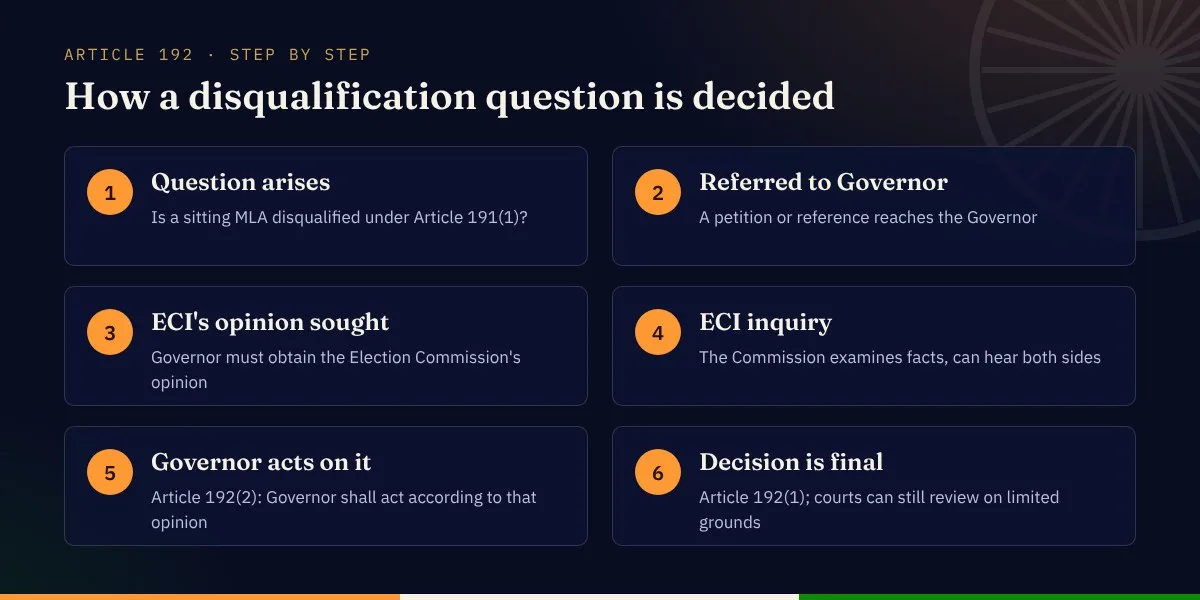
The process, step by step
- A question is raised — usually by a petition from a voter, a rival candidate or a party, alleging that a sitting MLA has incurred a disqualification after the election.
- The Governor refers it to the ECI for its opinion.
- The ECI inquires. It can call for documents and hear both sides. The Supreme Court has recognised that the Commission can make the inquiry needed to form its opinion.
- The ECI sends its opinion to the Governor.
- The Governor decides in line with that opinion, and the decision is notified.
- If disqualified, the seat falls vacant, and the ECI holds a by-election within six months, as a rule.
Article 192 deals with disqualifications that arise after a member is elected. Questions about whether a candidate was qualified on the day of election are generally raised through an election petition in the High Court under the Representation of the People Act.
Article 192 vs the anti-defection law
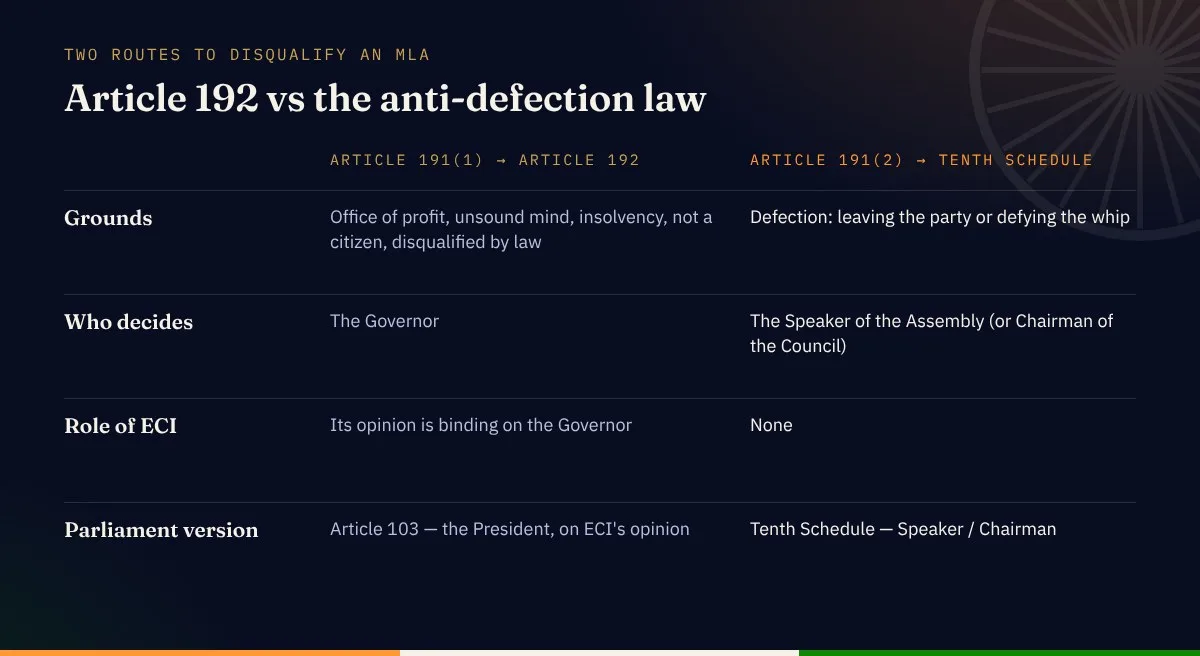
| Article 191(1) → Article 192 | Article 191(2) → Tenth Schedule | |
|---|---|---|
| Grounds | Office of profit, unsound mind, insolvency, citizenship, disqualified by law | Defection: voluntarily giving up party membership or defying the party whip |
| Who decides | The Governor | The Speaker (or Chairman of the Legislative Council) |
| Role of ECI | Its opinion is binding | None |
| Judicial review | Limited, on grounds such as mala fides or jurisdiction | Allowed on limited grounds (Kihoto Hollohan, 1992) |
Article 192 and Article 103: MLA vs MP
Article 192 is the state-level twin of Article 103, which applies to Members of Parliament. Under Article 103, the President decides questions of disqualification of an MP under Article 102(1), again acting according to the Election Commission's opinion.
| MP | MLA / MLC | |
|---|---|---|
| Grounds | Article 102(1) | Article 191(1) |
| Who decides | The President (Article 103) | The Governor (Article 192) |
| Binding opinion | Election Commission | Election Commission |
Why the ECI's opinion is binding
The framers wanted disqualification questions — often politically charged, such as "office of profit" cases — to be decided on legal merits, not by the party in power. Making the Governor act according to an independent constitutional body's opinion removes the state government's influence from the decision. In practice, office-of-profit complaints against MLAs and even Chief Ministers have been referred to the ECI under this Article.
Frequently asked questions
Under Article 192, who decides on the disqualification of an MLA, acting on the Election Commission's opinion?
The Governor of the state.
Can the Governor disagree with the Election Commission's opinion?
No. Article 192(2) says the Governor shall act according to the Commission's opinion.
Does Article 192 apply to defection cases?
No. Defection cases fall under Article 191(2) and the Tenth Schedule, and are decided by the Speaker or Chairman.
What is the equivalent provision for Members of Parliament?
Article 103, under which the President decides on the Election Commission's opinion.
What happens after an MLA is disqualified?
The seat falls vacant and a by-election is held, normally within six months.
More explainers: how Election Commissioners are appointed and removed · Article 332 and reserved seats.
Sources: Constitution of India, Articles 102, 103, 191, 192 and the Tenth Schedule; Representation of the People Act, 1951; Kihoto Hollohan v. Zachillhu (1992).