
Short answer: Article 332 of the Constitution of India provides for the reservation of seats for Scheduled Castes (SCs) and Scheduled Tribes (STs) in the Legislative Assembly of every state. The equivalent provision for the Lok Sabha is Article 330, and the time limit for both is set by Article 334.
Quick memory aid: 330 = Lok Sabha · 332 = State Assemblies · 334 = how long the reservation lasts · 243D / 243T = panchayats and municipalities.
What Article 332 says
- Clause (1): seats shall be reserved for SCs and for STs (with limited exceptions for the tribal areas of Assam) in the Legislative Assembly of every state.
- Clause (3): the number of reserved seats must be, as nearly as possible, in the same proportion to the total seats as the SC or ST population of the state bears to its total population.
- Clause (3A), added by the 57th Amendment (1987), makes special provision for ST seats in Arunachal Pradesh, Meghalaya, Mizoram and Nagaland (and Tripura under a related clause).
- Other clauses deal with autonomous districts in Assam.
Reserved seats are not separate electorates. Every voter in a reserved constituency votes, but only candidates belonging to the SC (or ST) community can contest there.
How reserved seats are decided
The exact constituencies are fixed by the Delimitation Commission. The current map comes from the Delimitation Order, 2008, based on the 2001 Census. Seats are generally reserved for SCs where their share of the population is relatively high, and for STs where tribal communities are concentrated.
Reserved seats in the 2027 poll states
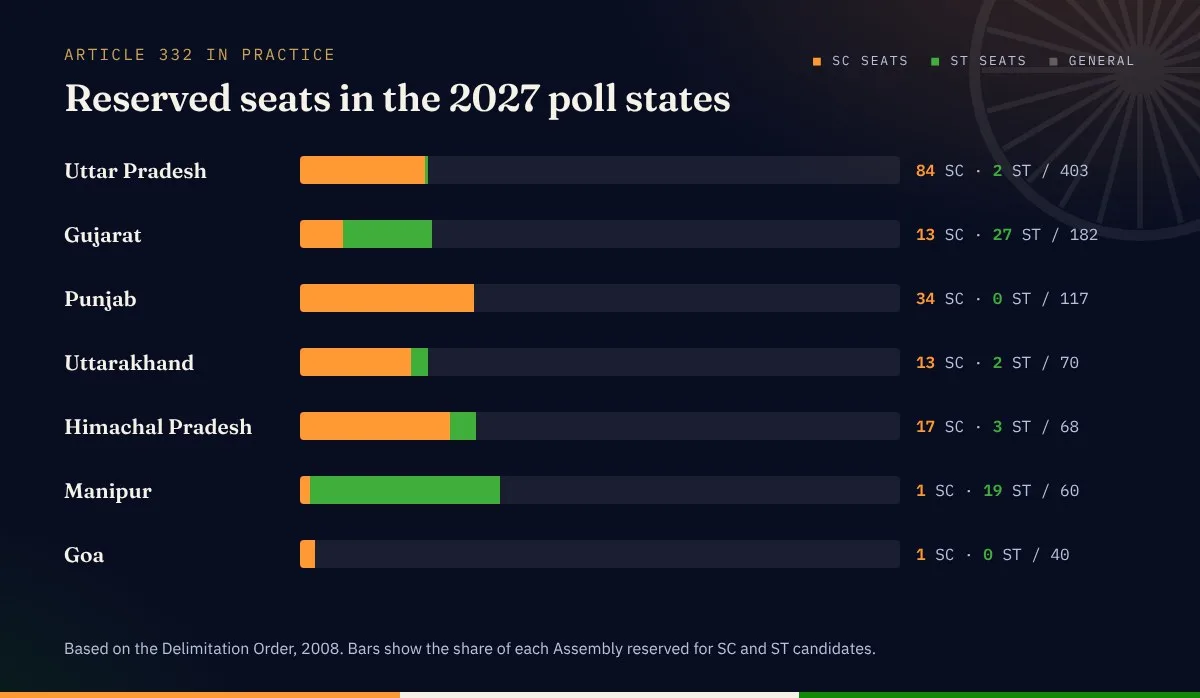
| State | Total seats | SC | ST |
|---|---|---|---|
| Uttar Pradesh | 403 | 84 | 2 |
| Gujarat | 182 | 13 | 27 |
| Punjab | 117 | 34 | 0 |
| Uttarakhand | 70 | 13 | 2 |
| Himachal Pradesh | 68 | 17 | 3 |
| Manipur | 60 | 1 | 19 |
| Goa | 40 | 1 | 0 |
Punjab has the largest SC share of the seven, while Manipur and Gujarat have large ST blocs. More on each state: which states have elections in 2027.
Related articles of the Constitution
| Article | What it does |
|---|---|
| 330 | Reservation of seats for SCs and STs in the Lok Sabha |
| 332 | Reservation of seats for SCs and STs in state Legislative Assemblies |
| 330A | One-third of Lok Sabha seats for women (106th Amendment, 2023) |
| 332A | One-third of Assembly seats for women, including within SC/ST seats (106th Amendment, 2023) |
| 333 | Nomination of Anglo-Indians to Assemblies (no longer in effect after 2020) |
| 334 | Time limit on SC/ST reservation and Anglo-Indian nomination |
| 243D | Reservation in panchayats |
| 243T | Reservation in municipalities |
Article 334: is the reservation permanent?
No. The Constitution originally provided for reservation for ten years, and Parliament has extended it every decade since. The 104th Amendment (2019) extended SC/ST reservation in the Lok Sabha and Assemblies until 25 January 2030, while ending the nomination of Anglo-Indian members.
Article 332A: women's reservation
The 106th Amendment (Nari Shakti Vandan Adhiniyam, 2023) inserted Article 332A, reserving one-third of seats in every state Assembly for women — including one-third of the SC and ST seats. It will take effect only after a delimitation exercise based on the first Census after the Act, so it will not apply to the 2027 Assembly elections.
Why reservation of seats exists
The framers of the Constitution, led by B. R. Ambedkar, saw political representation as necessary for communities that had faced centuries of exclusion. Reserved seats guarantee that SCs and STs have a voice in law-making in proportion to their population, while keeping a common electorate so that representatives answer to all voters. The arrangement followed debates in the 1930s, including the Poona Pact of 1932, which replaced separate electorates with reserved seats in joint electorates.
Frequently asked questions
Which article provides for reservation of seats for SC/ST in state Legislative Assemblies?
Article 332.
Which article provides for SC/ST reservation in the Lok Sabha?
Article 330.
Until when does SC/ST reservation in Assemblies last?
Until 25 January 2030 under Article 334, as amended by the 104th Amendment. Parliament can extend it again.
Can a general-category person vote in an SC-reserved seat?
Yes. All registered voters in the constituency vote; only the candidates must belong to the SC community.
Does women's reservation apply in the 2027 elections?
No. Article 332A applies only after the next delimitation, which follows the Census.
Sources: Constitution of India, Articles 330–334, 243D, 243T; Constitution (104th Amendment) Act, 2019; Constitution (106th Amendment) Act, 2023; Delimitation of Parliamentary and Assembly Constituencies Order, 2008.