
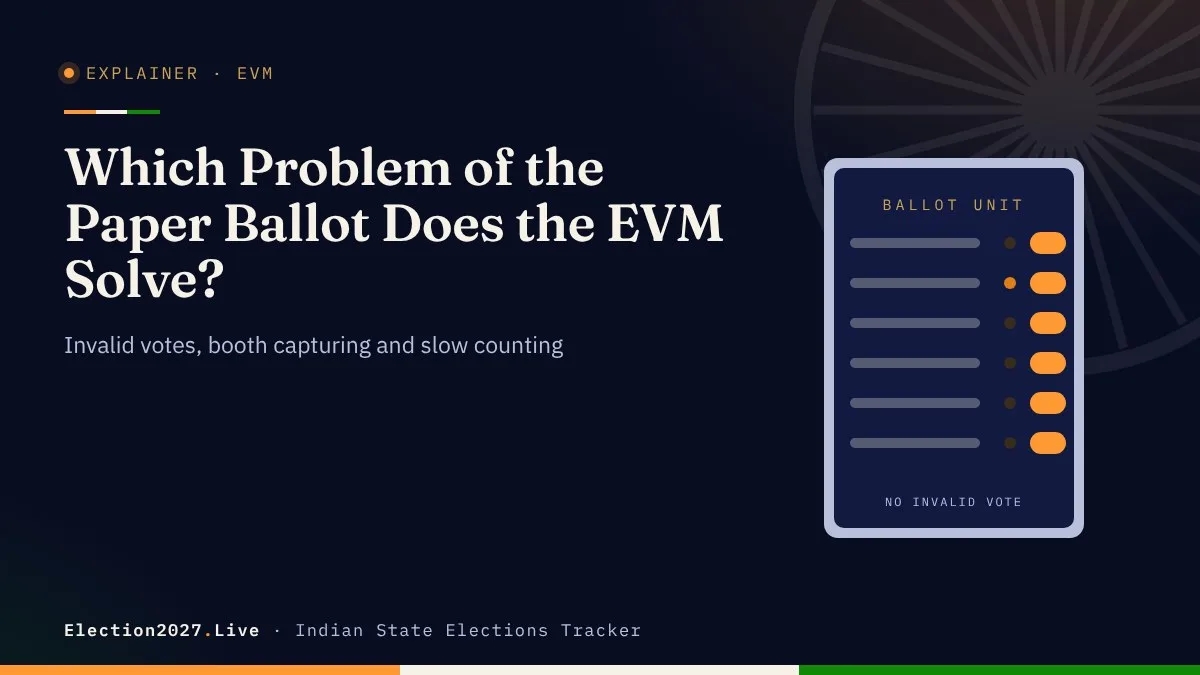
Short answer: the main problem of the paper ballot system that the Electronic Voting Machine (EVM) addresses is invalid votes. With paper ballots, a large number of votes were rejected every election because the stamp was placed on the line between two symbols, smudged, or marked more than once. With an EVM, a vote is a button press, so there is no such thing as an invalid vote.
EVMs also address several other weaknesses of paper ballots: booth capturing and ballot stuffing, slow and error-prone counting, and the cost and logistics of printing and moving crores of ballot papers.
One-line exam answer: EVMs eliminate invalid votes (and make booth capturing and ballot stuffing much harder). If the options include "invalid/void votes", that is usually the expected answer.
The problems with paper ballots
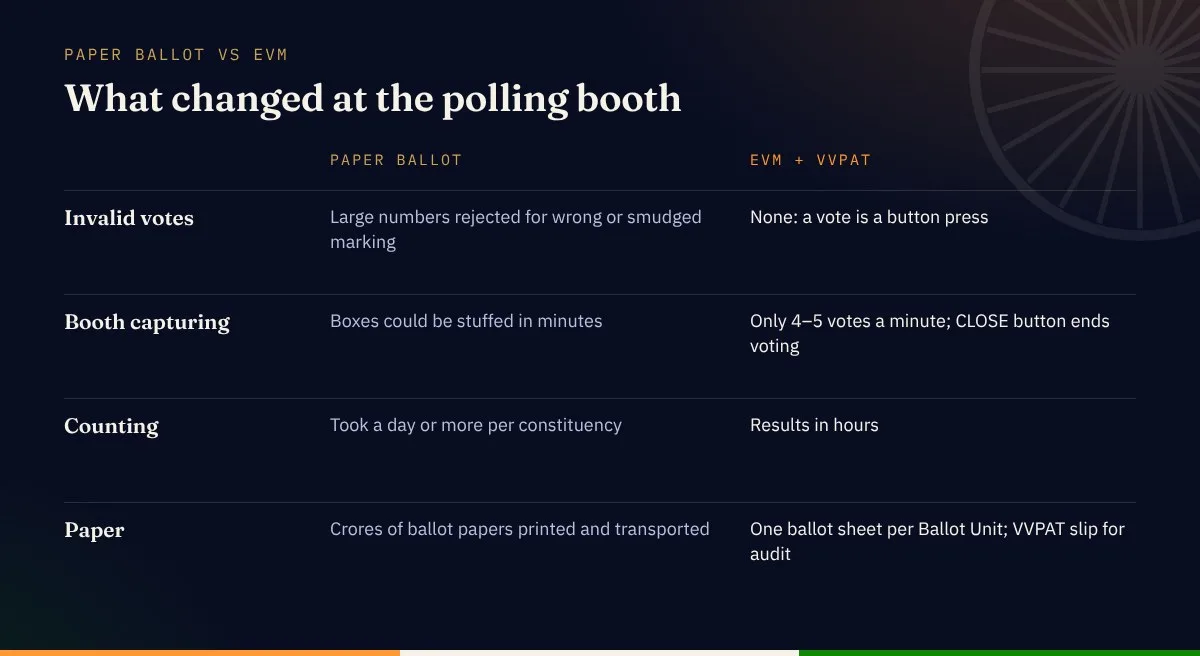
| Problem | What happened with paper ballots |
|---|---|
| Invalid votes | Votes were rejected for wrong, unclear or smudged marking |
| Booth capturing | Groups could seize a booth for a few minutes and stamp and stuff hundreds of ballots |
| Slow counting | Counting each constituency took many hours, often more than a day |
| Counting disputes | Recounts over doubtful ballots led to long arguments |
| Paper and logistics | Crores of ballot papers had to be printed, secured and transported |
How the EVM solves each problem
1. No invalid votes
A voter presses the blue button next to a candidate's name on the Ballot Unit. The machine records exactly one vote for exactly one candidate, so there is no ambiguous mark to judge. The ECI notes that invalid votes were seen in large numbers in every election under the paper ballot regime.
2. Booth capturing and ballot stuffing become pointless
- The Control Unit, kept with the presiding officer, must release each ballot before the voter can vote.
- The machine accepts only about four to five votes per minute, depending on the model. Stuffing hundreds of votes would take hours, giving security forces time to respond.
- When the presiding officer presses CLOSE, the machine accepts no further votes.
3. Fast, accurate counting
Results that once took a day or more now come within hours, because each Control Unit displays its total and candidate-wise count at the press of a button.
4. Less paper, lower cost
One ballot sheet is fixed on each Ballot Unit, instead of one paper per voter, and machines can be reused across elections.
5. Easier for every voter
Voters who cannot read can vote by recognising the party symbol and pressing a button, without worrying about stamping correctly.
VVPAT: adding a paper trail
Since 2013, EVMs have been connected to a VVPAT (Voter Verifiable Paper Audit Trail). After a vote, the VVPAT shows a printed slip with the candidate's serial number, name and symbol behind a glass window for about seven seconds, then drops it into a sealed box. VVPAT slips from a set number of randomly selected polling stations in every Assembly segment are counted and matched with the EVM count.
EVM history in India
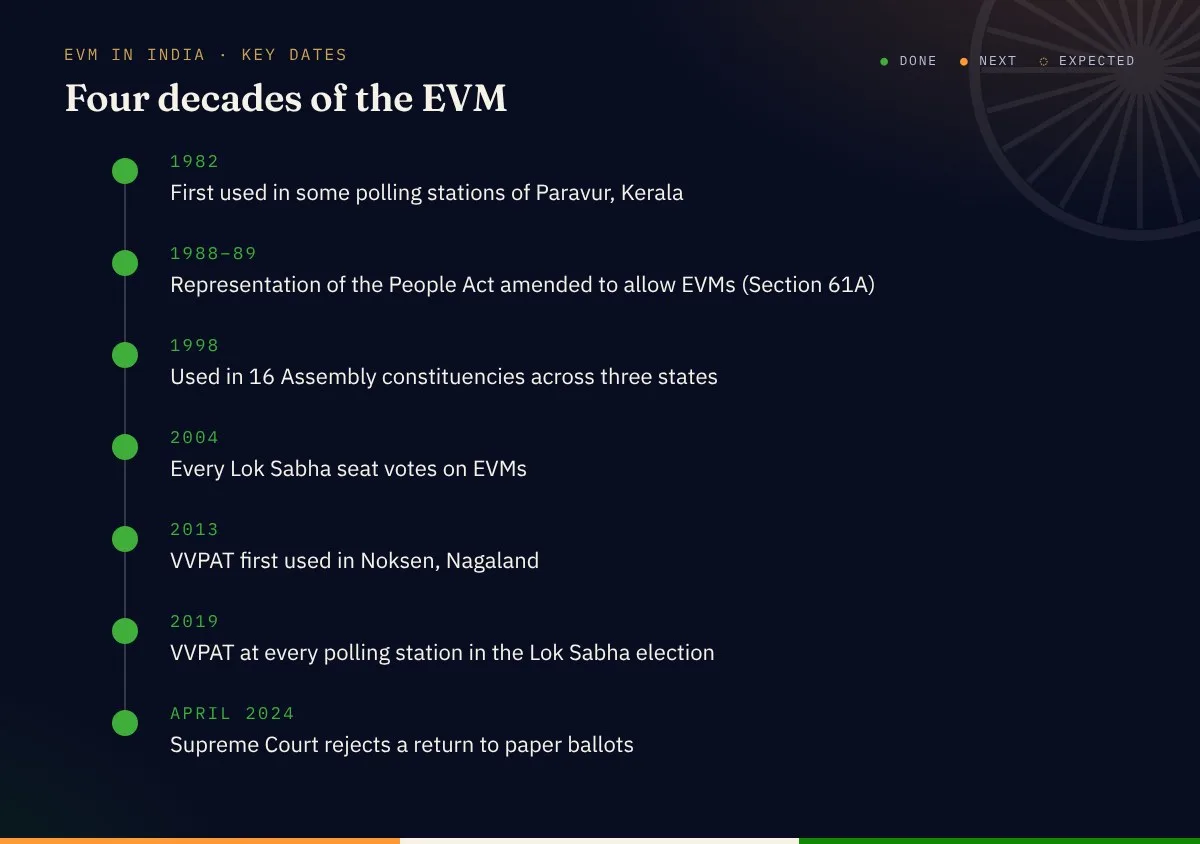
| Year | Milestone |
|---|---|
| 1982 | First used in some polling stations of Paravur, Kerala |
| 1988–89 | Representation of the People Act amended (Section 61A) to allow voting machines |
| 1998 | Used in 16 Assembly constituencies in Madhya Pradesh, Rajasthan and Delhi |
| 2004 | Every Lok Sabha constituency votes on EVMs |
| 2013 | VVPAT first used, in Noksen, Nagaland |
| 2019 | VVPAT at every polling station in the Lok Sabha election |
| April 2024 | Supreme Court rejects pleas to return to paper ballots or count all VVPAT slips |
The debate
Some political parties and activists continue to question EVMs and demand more VVPAT counting or a return to paper ballots. The ECI maintains that its standalone machines are not connected to any network, are sealed in the presence of candidates' agents, and undergo mock polls before voting. The Supreme Court, in April 2024, declined to order a return to paper ballots, while allowing candidates to seek verification of the machines' memory in limited cases. When you see viral "EVM hacking" videos, check whether they show actual ECI machines — see our guide to spotting election misinformation.
Note that paper ballots are still used in some local body elections, which are run by State Election Commissions — for example, Gujarat's 2025 gram panchayat polls. See Gujarat gram panchayat election date 2026.
Frequently asked questions
Which problem of the paper ballot system does the EVM address?
Mainly invalid votes. It also curbs booth capturing and ballot stuffing and speeds up counting.
How many votes can an EVM record per minute?
Only about four to five votes per minute, which makes mass fake voting impractical.
When were EVMs first used in India?
In 1982, in some polling stations of the Paravur Assembly constituency in Kerala. All Lok Sabha seats have used EVMs since 2004.
What is VVPAT?
A printer attached to the EVM that shows the voter a slip of the candidate they voted for, so the vote can be verified and audited.
Sources: Election Commission of India FAQs on EVMs (via PIB General Election 2024 compendium and state CEO websites); ECI manual on EVM and VVPAT; Supreme Court judgment in ADR v. Election Commission of India (April 2024).