
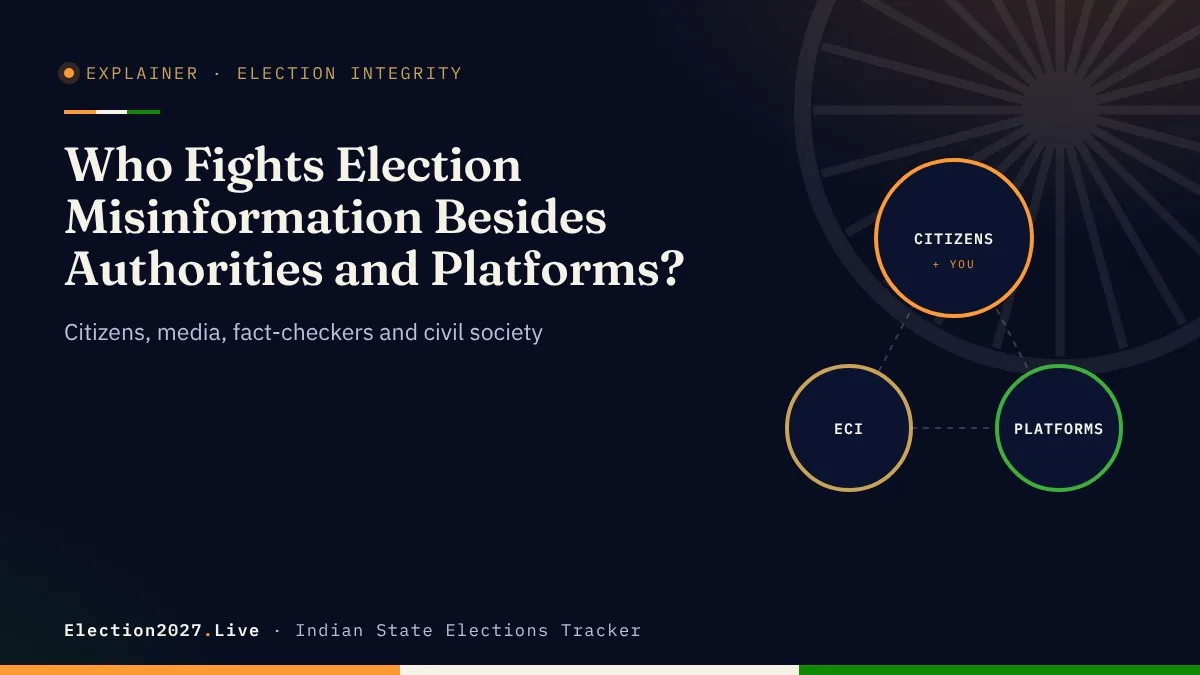
Short answer: besides authorities such as the Election Commission of India (ECI) and the online platforms that host content, the most important role in combating election misinformation is played by citizens themselves — informed, alert voters — supported by an independent media, fact-checkers and civil society groups that promote media and digital literacy.
The reason is simple: false claims spread mostly through people forwarding them to family and community groups. Rules and takedowns can only act after something is reported; a voter who stops to check before sharing breaks the chain at the source.
For quiz and exam answers: the expected answer is usually "citizens" / "voters" (or "civil society and the media", depending on the options). The idea behind it is shared responsibility: authorities make and enforce rules, platforms moderate, and citizens verify and refuse to amplify falsehoods.
The three pillars of fighting election misinformation
| Pillar | Who | What they do |
|---|---|---|
| Authorities | ECI, state Chief Electoral Officers, police, courts | Make rules (Model Code of Conduct, advisories), issue clarifications, act on complaints |
| Platforms | Social media, messaging and video platforms | Label, remove or reduce the reach of false content; respond to official notices |
| Citizens and society | Voters, journalists, fact-checkers, civil society, educators | Verify before sharing, report false content, correct it in their own circles, build media literacy |
Why citizens matter most
- Scale. India has close to 100 crore electors. No authority can monitor every family WhatsApp group; voters can.
- Speed. A false claim about a polling date or EVM tampering can travel faster than any official clarification. A single person refusing to forward it stops that branch.
- Trust. People believe corrections from someone they know more than from an institution.
- Reporting. Citizens are the ones who flag content to platforms and, for poll-code violations, through the ECI's cVIGIL app.
What the authorities do
The ECI has steadily tightened its rules on false and synthetic content:
- May 2024: during the Lok Sabha election, the ECI directed political parties to remove fake content from their social media within three hours of it coming to their notice, and warned them against using AI tools to create deepfakes.
- October 2025: before the Bihar election, a fresh advisory required parties to clearly label AI-generated or synthetic content — with labels such as "AI-Generated", "Digitally Enhanced" or "Synthetic Content" covering about 10% of the display — and to keep internal records of such material. Misleading AI content on official party handles must be taken down within three hours.
- 2026: the advisory was carried forward for the 2026 general and bye-elections, with action promised within three hours of misleading AI content being flagged.
- Myth vs Reality: the ECI publishes official fact-checks of viral claims through a "Myth vs Reality" register, now part of its ECINET platform, which the Commission has described as a tool to counter misinformation.
What platforms do
Platforms act on notices from the ECI and on user reports. They can remove content, add labels or fact-check notes, and reduce how widely a post is shown. In India, the platforms also operate under the IT Rules, which require them to act on lawful orders and run grievance mechanisms.
What the media, fact-checkers and civil society do
- Independent fact-checkers investigate viral claims and publish detailed debunks, often within hours.
- News organisations report verified results, explain processes like EVM sealing or VVPAT counts, and correct their own errors.
- Civil society and educators run digital-literacy workshops, especially for first-time voters and older people who are new to smartphones.
- Political parties and candidates are expected to follow the ECI's advisories and correct false content on their own handles.
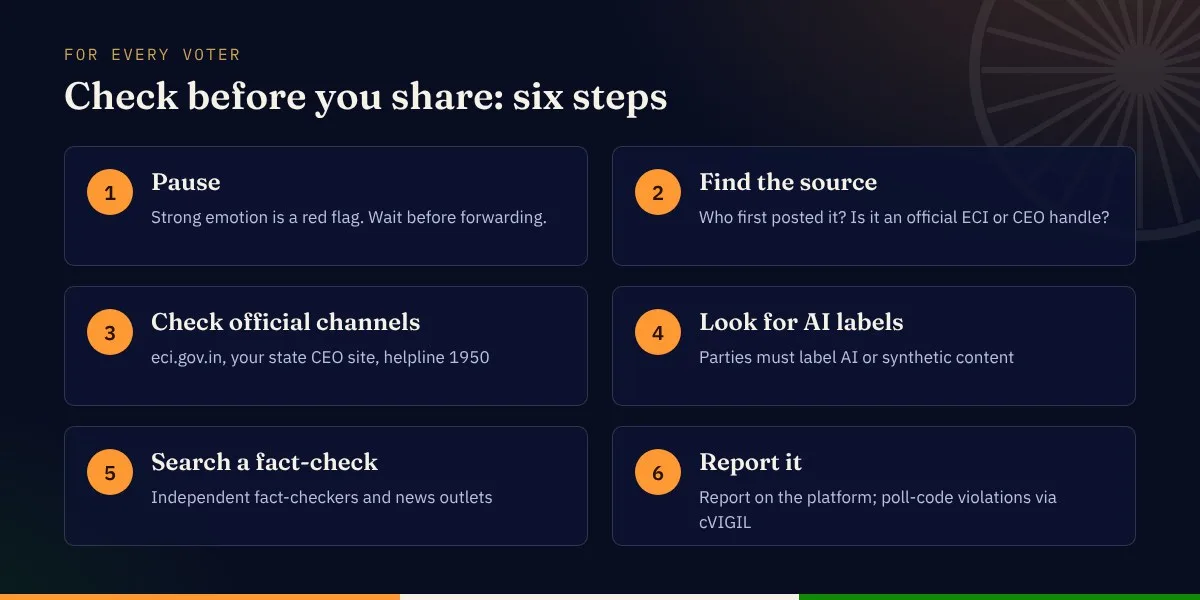
Check before you share: a voter's checklist
- Pause. If a message makes you angry or scared, treat that as a warning sign.
- Find the source. Who posted it first? Is it an official ECI or state CEO account?
- Check official channels. Polling dates, booth locations and your voter details are on eci.gov.in, your state CEO's website and helpline 1950. To check your enrolment, see our guide to adding your name to the voter list.
- Look for labels. Parties must mark AI-generated or digitally altered campaign content. An unlabelled, too-perfect video of a leader saying something shocking deserves extra caution.
- Search for a fact-check. Paste key words into a search engine with "fact check".
- Report, don't forward. Use the platform's report option. For Model Code of Conduct violations, use cVIGIL.
Common election myths to watch for in 2027
- Fake polling dates or "voting by SMS/online" — Indian elections do not allow online voting for general voters.
- Claims that your name has been deleted — check yourself on the official voter search instead of trusting a forward. Our SIR explainer (Hindi) explains how roll revisions work.
- EVM tampering videos — many are old clips or show machines that are not ECI EVMs. Read what problem the EVM solved.
- Fake opinion polls or "leaked results" — exit polls cannot legally be published until the last phase of voting ends.
Frequently asked questions
Under the Indian democratic system, who plays an important role in combating election misinformation besides authorities and platforms?
Citizens and voters — supported by the media, fact-checkers and civil society — by verifying information, refusing to spread false content and reporting it.
What did the ECI say about deepfakes?
It has told political parties to avoid deepfakes, to label AI-generated campaign content, and to remove fake or misleading content from their handles within three hours of it being flagged.
Where can I report election misinformation?
On the platform where you saw it; Model Code of Conduct violations can be reported through the ECI's cVIGIL app. Official clarifications are on the ECI website and helpline 1950.
Sources: ECI Press Note 72/2024 (6 May 2024); reporting on the October 2025 AI advisory by PTI/ThePrint, Deccan Herald and Business Today; Business Today on the 2026 advisory; ECI press note on ECINET (2025) and The Pioneer on its launch.